
Jonas Schmitt · 7 September 2026
Shifts in Gold Beating Workshops: How Artisans in Southeast Asia Meet Rising Demand from Global Designers
Gold beating workshops across Southeast Asia have undergone notable changes in recent years as artisans adapt their practices to supply increasing volumes of gold leaf for international design projects in architecture, fashion, and furniture making. Countries such as Thailand, Indonesia, and Vietnam host longstanding centers where workers transform thin gold sheets into delicate leaves through repeated hammering, and these facilities now incorporate updated equipment while preserving core manual techniques that date back centuries.
Traditional Methods Meet Modern Pressures
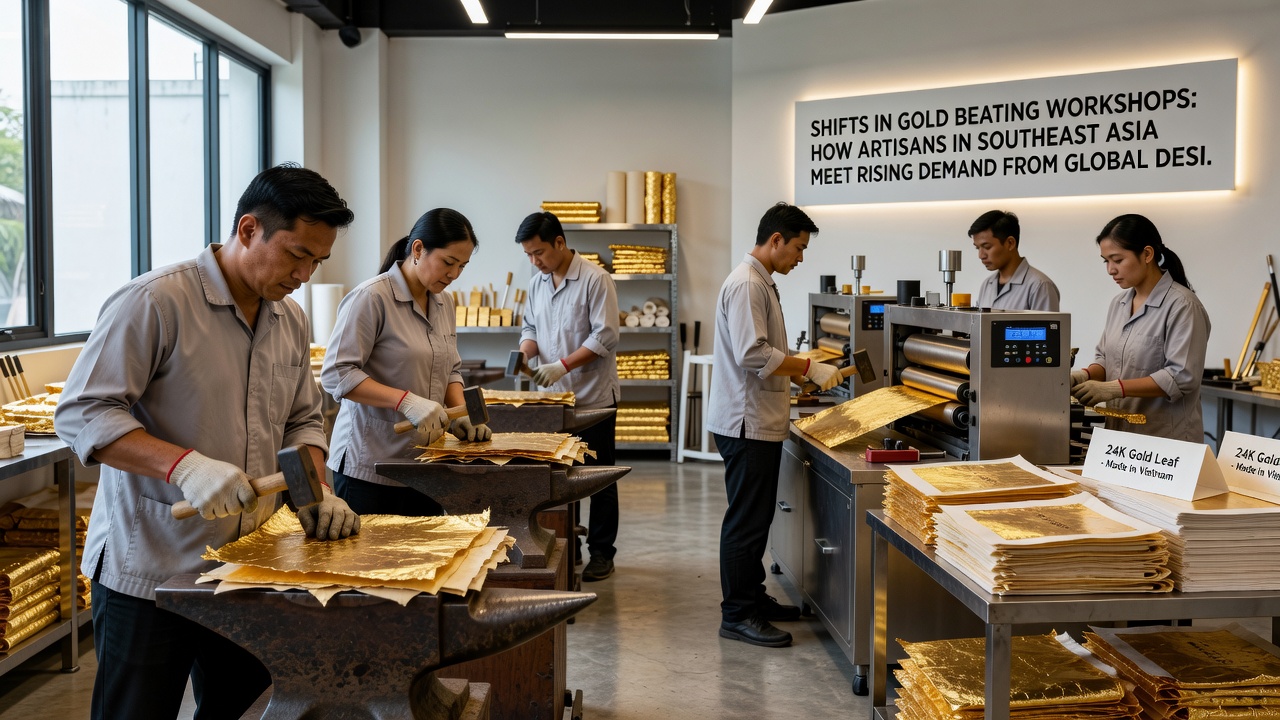
Artisans in these regions start with high-purity gold ingots that they roll into ribbons before cutting and beating them between layers of parchment or animal membrane, a process that requires precise control to achieve the standard 0.1 micron thickness used by designers today. Data from industry reports shows that production volumes in Thai workshops rose steadily between 2020 and 2025, driven by orders from European and North American studios seeking sustainable sourcing options. Workers often combine centuries-old hammer sequences with hydraulic presses for initial flattening stages, which reduces physical strain and allows teams to handle larger batches without compromising the leaf's uniformity.
Economic Factors Driving Workshop Adaptations
Global demand for gold leaf has climbed alongside growth in luxury interior projects and heritage restoration commissions, with figures from the World Gold Council indicating a 12 percent increase in industrial and decorative gold use across Asia-Pacific markets through 2025. Artisans in Indonesia's Yogyakarta region, for instance, have expanded their facilities to include climate-controlled drying rooms that prevent humidity damage during the final polishing steps, a direct response to specifications from designers working on large-scale installations. Training programs run by local craft associations now emphasize both hand skills and basic metallurgy knowledge, enabling younger workers to troubleshoot issues like uneven leaf edges that arise when scaling output.
Supply chain adjustments have also taken shape, as workshops source gold from regional refineries certified under international standards rather than relying solely on imported bullion. This shift supports faster turnaround times for custom orders, such as colored gold variants created by alloying small amounts of silver or copper during the melting phase. Observers note that these modifications help Southeast Asian producers compete with established European suppliers on cost while meeting quality benchmarks required for export markets.
Regional Examples of Production Scaling
In Vietnam's craft villages near Hanoi, family-run operations have added automated cutting machines that slice finished leaves into standard sizes demanded by bookbinders and gilders worldwide, yet the critical final hammering remains a manual task performed by skilled teams. A study from the National University of Singapore's Asian Studies program documented how these villages increased their annual output by 25 percent from 2022 to 2025 through such hybrid methods. Similar patterns appear in Malaysian workshops, where partnerships with design firms have led to the development of thicker gold leaf grades suited for outdoor architectural applications that withstand weathering.
September 2026 marks the scheduled release of updated ASEAN craft export guidelines that address traceability requirements for precious metal products, a move expected to streamline customs processes for gold leaf shipments to designers in Australia and Canada. Workshops are preparing by implementing digital inventory systems that track each batch from ingot to finished leaf, reducing paperwork delays that previously affected smaller producers.
Skill Transmission and Sustainability Measures
Passing knowledge to new generations continues through apprenticeships that pair experienced beaters with trainees for multi-year periods, ensuring that subtle judgments about gold temperature and hammer force stay intact even as machinery handles repetitive tasks. Research published in the Journal of Cultural Heritage Management highlights how these programs in Thailand incorporate modules on environmental practices, including recycling of membrane materials and energy-efficient lighting in work areas. Such steps align with buyer preferences for responsibly produced materials, as global designers increasingly request documentation on sourcing ethics.
Challenges persist around fluctuating gold prices and competition from synthetic alternatives, yet workshops counter these pressures by focusing on the unique tactile qualities of genuine leaf that automated factories cannot replicate. Collaborations with universities in the region have introduced testing protocols for purity verification, giving clients confidence in product consistency across large orders.
Conclusion
Artisans in Southeast Asian gold beating workshops continue to refine their operations in response to worldwide designer needs, blending inherited hammering expertise with targeted technological upgrades and supply adjustments. These developments position the region as a steady contributor to the global supply of gold leaf, supporting projects that range from intricate book covers to expansive building facades while maintaining the material's traditional characteristics.